

Download the CLA catering here.
Employment terms in jeopardy
The 4th round of negotiations on Thursday, 15 February was very challenging. The discussion mainly revolves around the employers' desire to move to a single set of employment terms. Employers explicitly intend to abolish Part A (applicable to employees who were employed before 1 April 2022) in the (near) future. Employers want to make this mandatory, so it would no longer be a voluntary choice for the employee.
FNV Catering is strongly opposed to this and proposes to maintain Part A and make Part B more attractive to switch to. This must always remain a voluntary choice for the employee. The negotiations seem to be deadlocked on this point.
What is your view on the employers' proposal? Let us know what you think, and we will take it into account during the next negotiations on Tuesday, 5 March.
- Employers have also presented a Membership deal (complete Membership) for the sector CLA. They assume, as previously mentioned, a single employment terms regime (Part A and B together) and a single salary scale. Since a new job and salary structure is being developed in hospitality from 1 January 2025, employers propose to align with this for the functions in contract catering and hospitality. Employers guarantee the rights of employees, ensuring no one will be worse off. This research starts soon and runs until the end of 2024. The outcomes will be input for the next CLA negotiations. Trade unions also want to align with the research of social partners in hospitality.
- Employers want a single system, namely the annual hours system, as it applies in Part B of the CLA. They also understand that there must be flexibility or self-management for the employee. Employees want to work more at one moment to be able to take a whole day off at a desired moment. In Part A, this is done with the build-up of ADV, and such a method should be an option in Part B.
- Employers want to improve the plus Membership of Part B but keep it equal in value. They propose to scrap the agreement on the learning account because there is already a 2% norm for training. With the money freed up, they want to increase the travel allowance to 21 cents per kilometre (currently 15 cents in A and 19 cents in B) and expand the number of kilometres to 40 (currently 10-30 kilometres). This would then apply to all employees because, in the employers' proposal, all employees are in one set of employment terms. They also want to maintain youth wages, which have been reduced in the hospitality CLA.
- Furthermore, they want employees to have more room for study leave, bereavement leave, caregiving, or not working on non-Christian holidays. These are proposals we can agree with.
Employers understand that there are matters valuable to employees in Part A that may form a barrier to switching to Part B now. Therefore, they want to know from us which arrangements should be structurally established in Part B to legally and emotionally secure this for employees. And whether this should only apply to employees currently in Part A or to all employees.
Employers want to apply the salary increase for employees in Part B as done in the hospitality CLA. Because the salary structure of Part A differs slightly, the following differentiated increase is proposed for those employees based on the salary on 31 December 2023:
- 9.5% for salary scale 1 with a check on the statutory minimum salary (WML)
- 10.5% for salary scale 2 with a check on the WML
- 12% for salary scale 3
- 12% for salary scale 4
- 9% for salary scale 5
- 8% for salary scale 6 to 9
Regarding the duration of the CLA, employers propose to maintain one year.
What do you think?
Tuesday, 5 March is the next round of negotiations for the sector CLA. It will then be the turn of the trade unions to present their (counter)offer. What is your view on the employers' proposals, particularly the major sticking point of whether or not to retain employment terms Part A and the voluntary choice of the employee to switch or not? Send us an e-e-mail.
Inflight negotiations
Trade unions and employers have extensively discussed the number of flights, turnover rates, and the required number of employees. The recovery after the pandemic was faster than expected. To keep up with this growth, there is insufficient staff. This is exacerbated by the tight labour market and existing employment terms. This makes recruitment difficult and increases the workload for Updates colleagues.
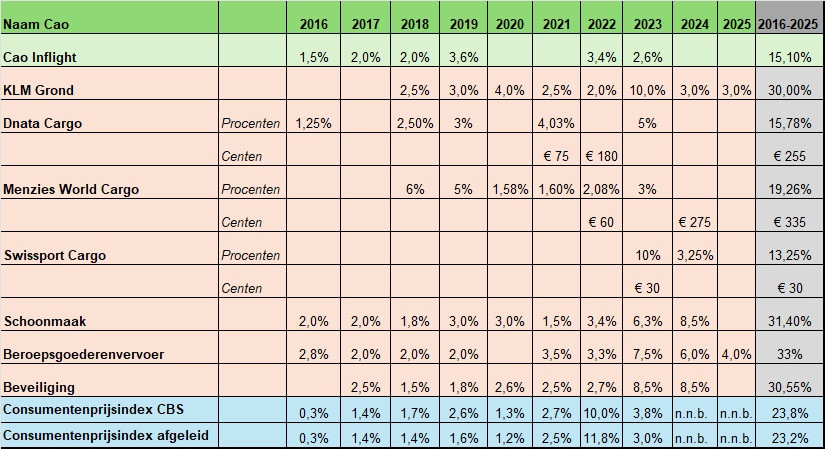
How can inflight be made more attractive to achieve the expected growth in 2024? We have researched other CLAs at Schiphol. It shows that with an attractive Membership of employment terms, we can keep up with the competition in the labour market. This means that salaries need to be improved and a salary increase this year.
See the CLA comparison table below
On 22 February and 7 March we will continue discussions with employers about the inflight.